
GRP anti-slip product guide
Match the anti-slip product to the surface and route.
Choose sheets, strips, stair covers, nosings, rung covers or larger walkway and ramp covers around the existing substrate, traffic and exposure.
Find the practical starting point
The selector identifies the product format most likely to fit the area. Final fixing, adhesive and substrate preparation still need checking.
Suggested starting point
Anti-slip step covers
A full cover improves grip across the tread and can introduce a contrasting leading edge.
Explore this routeChoose by coverage
The product should cover enough of the risk area without creating avoidable joints, trip edges or difficult fixing details.

Steps and nosings
Use full covers for tread-wide grip or nosings where the leading edge is the main concern.
Compare stair products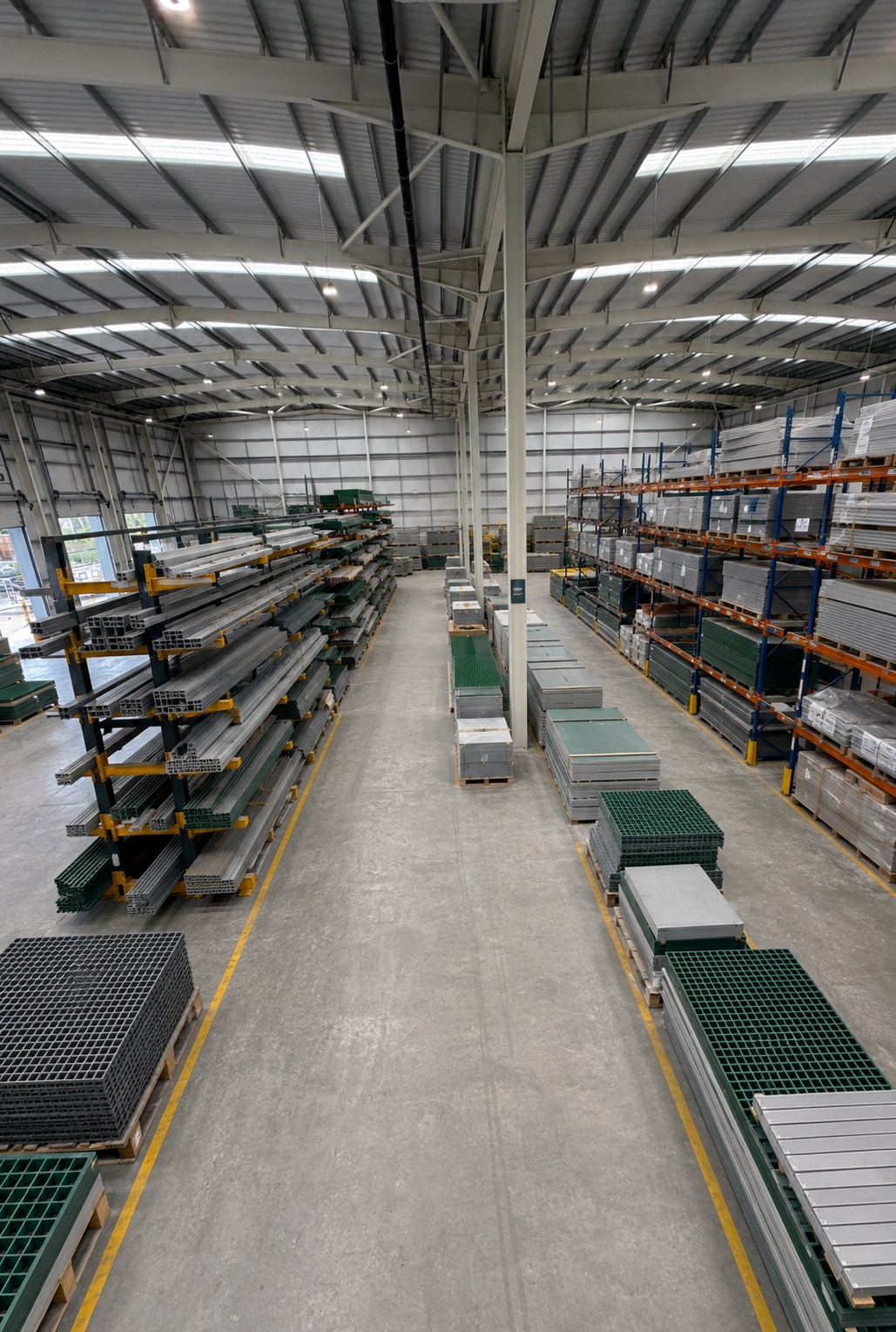
Sheets and strips
Sheets cover broader areas; strips create targeted routes on sound existing surfaces.
Compare sheets and strips
Ramps and walkways
Larger covers help create a continuous route over ramps, landings and service walkways.
Review ramp coversSpecification and installation checks
Anti-slip performance depends on the chosen product, its condition and the installation beneath it.
| Check | What to record | Why it matters |
|---|---|---|
| Substrate | Concrete, steel, timber, GRP or decking; soundness, corrosion and contamination. | Controls preparation, fixing and adhesive choice. |
| Traffic | Pedestrians, footwear, trolleys, maintenance frequency and direction of travel. | Helps define coverage, joints and edge details. |
| Contamination | Water, oils, grease, powders, mud, ice or cleaning chemicals. | Influences cleaning, grit choice and maintenance planning. |
| Geometry | Width, length, curves, nosings, drainage points and obstructions. | Determines standard sizing, cut-to-size or drawing-led preparation. |
| Fixing access | Drilling access, underside access, edge distances and cure conditions. | Mechanical fixings and adhesive commonly work together. |
| Visibility | Lighting, colour contrast and leading-edge identification. | Especially important on stairs, level changes and external routes. |
Send measurements that can be made
Cut-to-size anti-slip products can reduce site trimming, but the drawing needs to describe the finished piece clearly.
Anti-slip product questions
Should I choose anti-slip strips or a full sheet?
Strips suit targeted pedestrian routes and local grip improvements. Sheets are usually better where the risk extends across a wider landing, floor or working area.
What is the difference between a stair nosing and a step cover?
A nosing focuses on the leading edge. A step cover extends across more of the tread and is the stronger route when grip is needed over the full step.
Can anti-slip GRP be fitted to steel, timber or concrete?
These are common substrates, but preparation and fixing differ. Record the material, condition, thickness, drilling access and contamination before choosing adhesives or mechanical fixings.
Can anti-slip products be cut to complex shapes?
Yes, suitable products can be prepared to dimensions or drawings, including repeat pieces and selected notches or openings. Tolerances and fixing edges should be agreed first.
Does a gritted surface remove the need for cleaning?
No. Grit can become masked by oils, mud, powders or biological growth. Inspection and cleaning remain part of maintaining a safe route.
When should the existing stair or floor be replaced?
If the substrate is structurally unsound, badly corroded or unable to accept reliable fixings, an overlay is not the answer. The underlying structure needs separate review.
Have dimensions, photos or a repeat-piece drawing?
Send the surface details and we can help route the enquiry towards standard products or cut-to-size preparation.
Technical specification checkpoint
Technical evidence behind an anti-slip specification
A useful specification records the test method, surface condition, contaminant, intended duty and how performance will be maintained. A product description or a single headline rating is not enough.
| Specification area | What to establish | Engineering boundary |
|---|---|---|
| Pendulum test | BS 7976-2:2002+A1:2013 method and competent operation; HSE classifies PTV 36+ as low slip potential for the stated condition. | Do not treat a dry result, ramp class or unqualified coefficient of friction as an equivalent wet PTV. |
| Ramp classifications | DIN 51130 R9–R13 and DIN 51097 A–C use different footwear and contaminants. | Useful supplementary data, but HSE cautions against substituting these bands for representative pendulum testing. |
| Trafficked performance | Record retained performance after a stated trafficking or wear procedure where high footfall is important. | Confirm that the tested construction and aggregate match the supplied product. |
| Risk assessment | Workplace surface, contamination, use, footwear, behaviour, environment and cleaning. | A low-slip-potential surface does not eliminate management, housekeeping or drainage duties. |
Important: Avoid unsupported phrases such as “non-slip”, “zero maintenance” or universal “compliance”. State the measured performance, condition and limits.
Primary references: HSE GEIS2; Approved Document K; and the relevant current project, accessibility and asset-owner requirements.
Choose the next anti-slip page
Move from product guidance into the exact anti-slip format.
These routes help customers compare sheets, strips, covers and nosings after reading the buying guide.