
GRP grating buying guide
Choose grating around the site, span and people using it.
Compare standard mesh, mini mesh, micro mesh, solid top and pultruded flooring before selecting panel depth, fixings or cut sizes.
Find the most likely product route
This selector narrows the range from the practical requirement. It does not replace a span, load or deflection check.
Suggested starting point
Standard mesh grating
A versatile open surface for drainage-friendly industrial walkways and platforms.
Explore this routeCompare the five grating routes
Opening size, drainage, wheel traffic, containment and load direction are usually more useful starting questions than colour or panel size.
| Route | Best starting fit | Watch for | Next check |
|---|---|---|---|
| Standard mesh | General industrial access, walkways, platforms and wet areas requiring drainage. | Footwear, dropped objects, cut edges and point loads. | Standard mesh options |
| Mini mesh | Smaller openings, riser voids, public maintenance routes and improved object retention. | Actual opening size, ball-fall requirement and cleaning access. | Mini mesh options |
| Micro mesh | Small wheels, varied footwear and routes needing an especially small open aperture. | Wheel diameter, grit finish, drainage and project-specific access rules. | Micro mesh options |
| Solid top | Closed anti-slip floors, visual screening, debris containment and service covers. | Drainage falls, panel weight, lifting access and support spacing. | Solid top options |
| Pultruded flooring | Directional strength, engineered access floors and support-led longer spans. | Load direction, deflection, bearing width and drawing review. | Pultruded flooring route |
Specify in the right order
The quickest reliable enquiry starts with the structure and use, then moves into the product details.
Measure clear span
Record the unsupported distance between bearing supports, not the overall panel size.
Define the load
Separate distributed pedestrian loads from point loads, trolley wheels, plant and maintenance loads.
Set deflection expectations
Comfort, removable covers and sensitive equipment may need tighter deflection criteria.
Choose the opening
Consider drainage, footwear, dropped objects, wheel traffic and visual screening.
Confirm environment
Wet, coastal, chemical, food, fire-sensitive and electrical sites may need different specifications.
Plan supports and fixings
Check bearing, clips, edge support, removable panels, penetrations and access below.
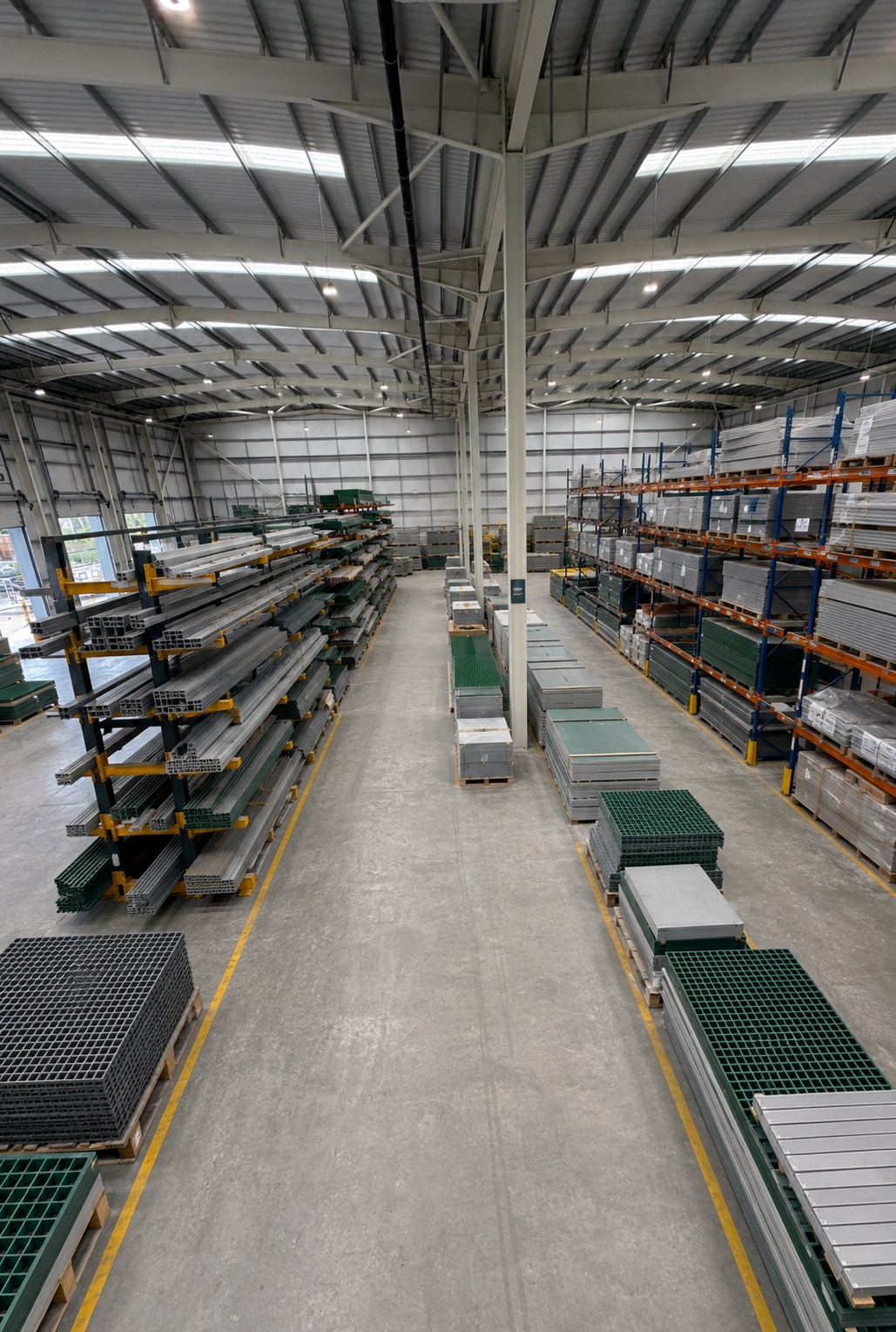
Cut-to-size and CNC-style preparation
Straight cuts are only part of many projects. GRP Express can route enquiries for repeat panels, notches, penetrations and complex shapes when supplied with clear drawings.
GRP grating questions
What information is needed to select GRP grating?
Start with clear span, support direction, load type, deflection requirement, environment, opening preference and any cut-outs. Panel dimensions alone are not enough for a load-led selection.
When should I choose mini or micro mesh?
Use a smaller mesh route when footwear, small wheels, dropped objects or a project ball-fall requirement makes standard openings unsuitable. Confirm the actual aperture rather than relying on the product name alone.
Does solid top grating still need drainage planning?
Yes. A closed surface can retain water or contaminants, so falls, joints, edge details and cleaning access should be considered before installation.
Can GRP grating be CNC cut?
Complex and repeatable shapes can be prepared from suitable drawings. The panel orientation, support arrangement, edge condition and tolerance must be reviewed before production.
How are grating panels fixed?
The clip or recess-plate route depends on grating depth, mesh format, support material, access below and whether panels need to remain removable.
Is the selector a structural calculation?
No. It identifies a likely product family. Final selection must use verified product data and project-specific span, load, support and deflection checks.
Have a span, drawing or panel list?
Send the practical details and we can help route the enquiry towards stocked panels, load guidance or cut-to-size project support.
Technical grating checkpoint
Select grating by system performance—not depth alone
A defensible grating specification combines construction type, clear span, load case, deflection, aperture, surface, resin, fire evidence, support and fixing. Panel depth by itself does not establish suitability.
| Specification area | What to establish | Engineering boundary |
|---|---|---|
| Moulded open mesh | BS 4592-6 with BS 4592-0 common requirements. | Verify moulded bearing direction, depth, clear opening, load table and panel restraint. |
| Pultruded/open bar | BS 4592-4 with BS 4592-0 common requirements. | Primary bearing bars are directional; cross-rods do not make the panel equally structural both ways. |
| Solid plates | BS 4592-5 with BS 4592-0 common requirements. | Distinguish a structural plate from a thin cover bonded to a grating or existing floor. |
| Machinery access | BS EN ISO 14122-2:2016 may apply to permanent platforms and walkways serving stationary machinery. | Do not cite it as the universal standard for every building, trench or public route. |
Important: Never transfer a span from another manufacturer, depth or mesh. Use the load/deflection data for the exact supplied construction and support direction.
Primary references: relevant current parts of BS 4592; ISO 14122-2:2016 where machinery access is in scope; and project-specific load, fire, chemical and access requirements.
Expert specification workflow
The shortest reliable buying route starts with the installed duty
Select in a fixed order: application, governing requirements, loads, clear spans, opening control, environment, product construction, surface, supports, cuts and fixings. Reversing that sequence—choosing a depth or colour first—creates avoidable technical risk.
1. Define demand
- Users and access frequency.
- UDL, concentrated, wheeled and maintenance loads.
- Deflection or movement limit.
- Slip, opening and fire requirements.
2. Define geometry
- Clear span between bearing faces.
- Support width and material.
- Panel joints, edges and penetrations.
- Falls, drainage and level transitions.
3. Select and verify
- Exact moulded, pultruded, solid-top or plate product.
- Product-specific load evidence.
- Resin and surface for exposure.
- Cut plan, fixing schedule and inspection route.
Minimum enquiry schedule
Provide a marked-up plan, finished cut sizes, span direction, support centres and widths, load cases, deflection criterion, mesh-opening requirement, environment, surface, colour, resin or fire specification, openings, fixings, delivery constraints and any removable-panel requirement.
Common selection errors to eliminate
- Using overall panel length as the unsupported span.
- Applying one product’s load table to another mesh or resin.
- Treating a concentrated load as an equivalent UDL without verification.
- Rotating directional grating to improve cutting yield.
- Leaving cut edges, penetrations or panel joints unsupported.
- Assuming a gritted surface removes the need for contamination control.
Expert buying-guide FAQs
What is the most important dimension when selecting grating?
The clear unsupported span between bearing faces is fundamental, but it must be assessed alongside the exact product, loads, deflection criterion and support arrangement.
Why must concentrated loads be stated separately?
A local load can control bending, punching, surface damage or user comfort even where the total distributed load appears modest.
Can the cheapest panel be made suitable by adding clips?
No. Clips do not increase the structural span or replace supports. Economy should be assessed across the panel, support steelwork, cutting, installation and maintenance.
What closes the specification before ordering?
A product-specific check that reconciles the load data, cut plan, supports, fixings, environment and applicable project requirements for the installed layout.
Continue the buying route
Move from the buying guide into the right grating category.
These links keep buyers moving from selection advice into product families, load checking and enquiry routes.