
GRP Handrail Systems
GRP Handrails
Corrosion-resistant GRP handrails, posts, rails and fittings for platforms, walkways, stairs and industrial access routes.
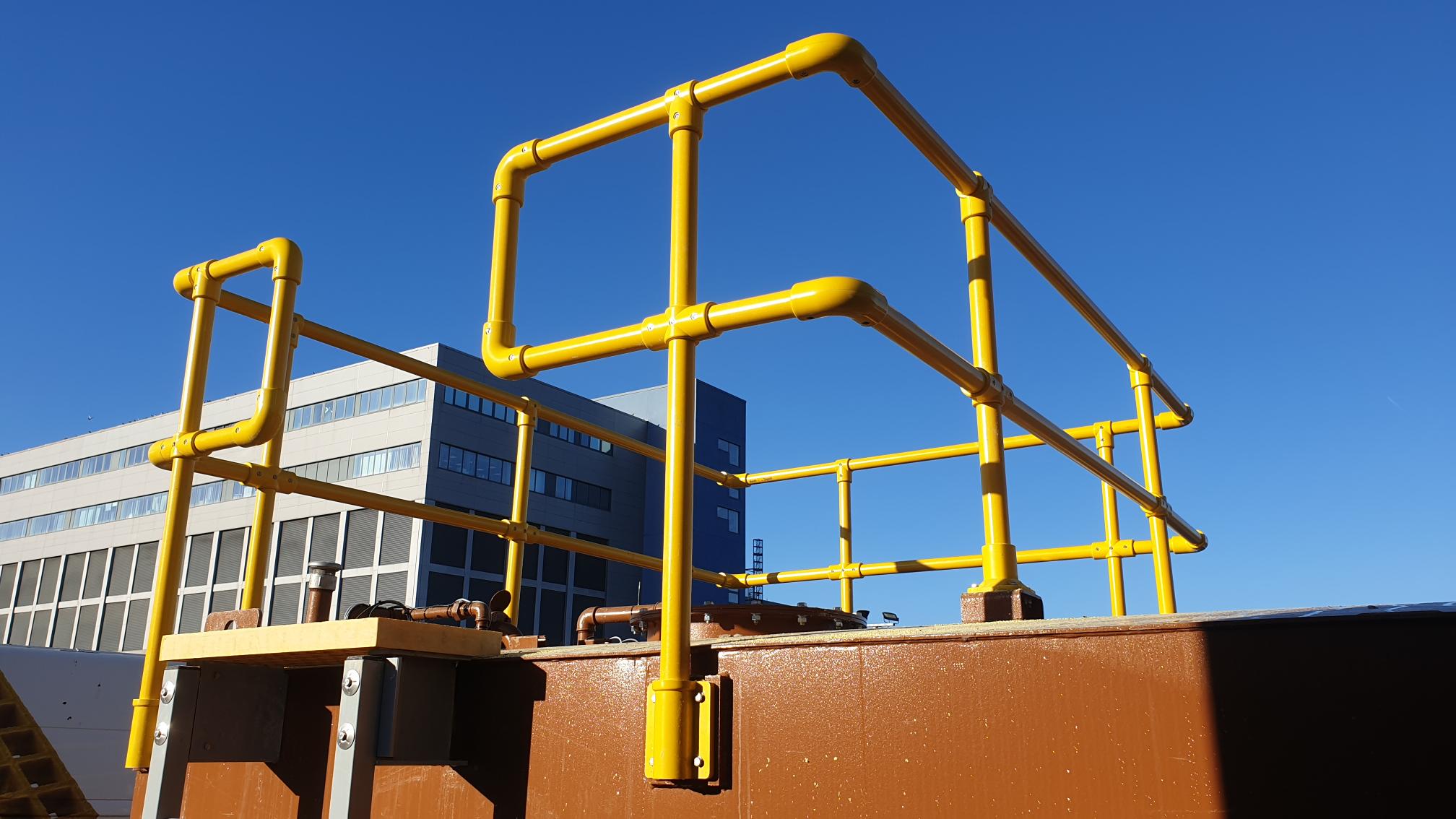
GRP handrail components
Posts and baseplates
Posts and baseplates create the main upright support points for platform, walkway and stair handrail runs.
Rails and mid-rails
Top rails and mid-rails complete the guarding arrangement between posts and around access edges.
Fittings and fixings
Fittings, connectors and fixings help form corners, joins, returns and project-specific handrail layouts.
Why choose GRP handrails?
- Corrosion-resistant for wet, exposed, coastal and industrial environments.
- Lightweight and easier to handle than many metal systems.
- Non-conductive and suitable for many electrical and rail-adjacent applications.
- Useful for platforms, walkways, stairs, ramps, gantries and plant access.
- Can be planned as a project layout with posts, rails, toe boards, fittings and cutting requirements.
Planning a GRP handrail run
A good quote starts with a clear layout: run lengths, corners, openings, stairs, ramps, fixing surfaces, handrail height and whether toe boards or kick plates are needed.
For larger projects, send drawings, site photos or a marked-up sketch. The more layout detail you provide, the easier it is to shape a practical component list.
Useful details to send
- Run lengths and layout sketch
- Platform, stair or ramp details
- Fixing surface and baseplate needs
- Posts, rails, toe boards and fittings required
- Delivery postcode and target date
Trade support
Handrail quote tools for repeat projects
Handrail projects often repeat across sites, access routes and customer standards. Trade workflows can help turn layouts into saved requirements, component lists and repeatable quote conversations.
Need a GRP handrail quote?
Send the layout and access details and we can help shape the component requirements.
Related sector pages
Where GRP handrails are commonly specified
Route handrail customers into sector pages where corrosion, exposure and safe access drive the specification.
Specialist Vital GRP product family
SafeClamp® modular handrail family.
SafeClamp is the Vital GRP identity for compatible modular handrail components. Confirm the required layout, duty, post spacing, rails, base details and fixings before ordering.
How GRP Express is supported
GRP handrail system engineering
A modular GRP handrail is governed by the weakest verified part of the assembled run. Rail bending, post bending, fitting rotation, baseplate stiffness, anchors and substrate resistance must be checked together.
Geometry
- Set finished barrier/handrail height from the correct project standard.
- Control openings, mid-rail position, toe-board height and clearance.
- Detail corners, returns, changes in level, gates and termination points.
Actions
- Apply the specified line, point and infill loads at the correct height.
- Check strength and serviceability deflection of the complete assembly.
- Include wind, maintenance, accidental or crowd actions where the project requires them.
Interfaces
- Verify post centres rather than copying a generic maximum spacing.
- Check baseplates, anchors, edge distances and supporting substrate.
- Define movement joints, removable bays and isolation from dissimilar materials.
For pultruded rails and posts, use declared properties for the exact profile and fibre direction. For moulded fittings, use system test or manufacturer data rather than assuming they inherit the profile capacity.
Specification note: Do not describe a handrail run as BS 6180 or BS EN ISO 14122 compliant unless the exact configuration, load category, deflection, connections, anchors and supporting structure have been verified.
Expert system specification
Treat the installed handrail as one structural system
System performance depends on the tested or calculated configuration—not the material name. Profile stiffness, post centres, connection slip, base restraint and anchor flexibility all affect load and deflection.
| System decision | Information to establish | Engineering boundary |
|---|---|---|
| Configuration evidence | Exact profile/fitting family, post spacing, rail arrangement, fixing method and test/calculation basis. | A test certificate applies only to the configuration, spacing and boundary conditions represented. |
| Deflection | Permitted system movement at the design action plus residual deformation where relevant. | Strength alone is insufficient if excessive movement creates loss of confidence or opens interfaces. |
| Corners and ends | Return rails, end posts, changes in direction, termination and unbalanced loading. | Do not assume a straight test bay proves every corner, stair and free-end condition. |
| Durability | UV, chemicals, cut edges, moisture traps, stainless-grade selection and inspectability. | Corrosion resistance reduces maintenance; it does not eliminate inspection or environmental compatibility checks. |
Responsibility boundary: SafeClamp® is the Vital GRP modular handrail family. GRP Express can supply compatible components and prepared material, but verified system claims must match the precise installed configuration.
Technical questions
What determines GRP handrail capacity?
The complete configuration: rail and post profiles, post spacing, fittings, base restraint, anchors, load position and support stiffness.
Can post spacing be increased to reduce component count?
Only where calculations or representative testing verify the revised spacing, loading, deflection and connections.
Do GRP handrails need maintenance?
Yes. Inspect profiles, fittings, fasteners, anchors, gates, toe boards and interfaces at a frequency based on use and environment.
Is GRP electrically non-conductive in every installation?
GRP profiles have useful dielectric properties, but moisture, contamination, carbon-containing components, metal fixings and the complete installation must be considered by the project’s electrical specialist.
Complete the handrail run
Connect handrails with posts, mid-rails, fittings and quote tools.
Use these pages to move from top rail selection into a complete GRP handrail system.
Specify warm-to-touch handrail where public access and comfort matter.
For exposed, accessible or public-facing routes, link GRP handrails to the warm-to-touch and Part M specification journey before pricing.
GRP handrail system
Buy GRP handrails or request a complete system quote
Choose rail components where the system is known, or send drawings and route lengths for a coordinated handrail package.
Where Part M, DDA, warm-to-touch or colour contrast requirements apply, use the specification route before ordering.
GRP handrail, fibreglass guardrail and safety railing
Industrial GRP handrail systems are also searched for as GRP guardrail, fibreglass handrail, FRP handrail, GRP safety railing and GRP edge protection. The terminology varies by sector, but the buying requirement normally combines posts, rails, fittings, kick plates, gates and fixings into a complete barrier route.
Use the handrail system pages to select GRP handrail components and fittings for platforms, stairs, walkways and industrial access areas.
GRP balustrades, guardrails and edge-protection systems
Handrail searches may also use GRP balustrade, fibreglass balustrade, GRP guardrail, safety railing and edge protection. The appropriate arrangement depends on the route, guarding height, loads, post spacing, base detail and applicable access requirements.