
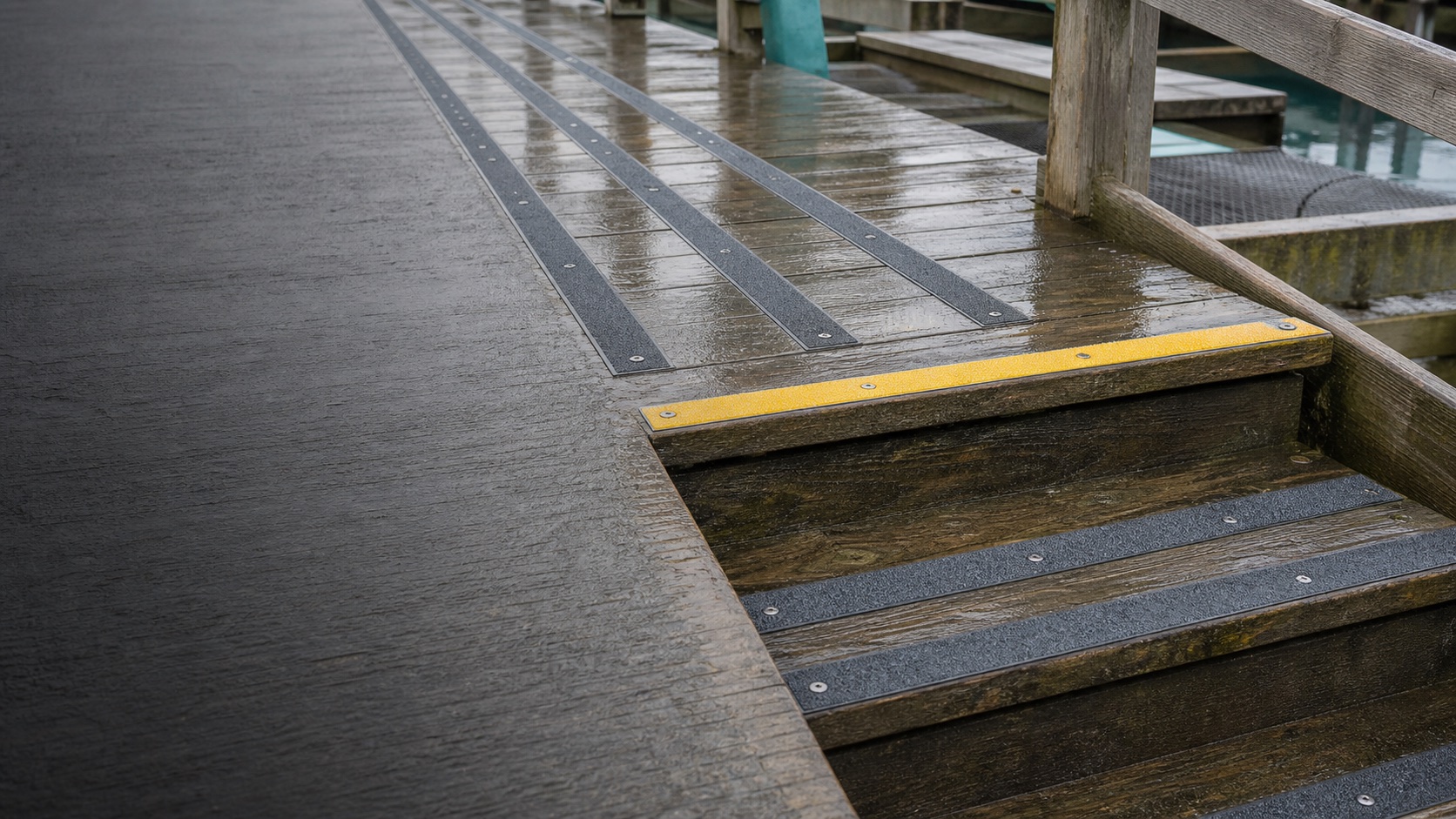
Targeted retrofit grip
GRP Anti-Slip Strips
Add practical grip to walkways, steps, ramps, decking and high-risk pedestrian routes without covering the entire surface.
Where anti-slip strips are used
Walkway routes
Add grip lines to pedestrian routes, service walkways, access paths and areas where full sheet coverage is not required.
Steps and ramps
Use strips to improve traction on steps, ramps, thresholds and transition points exposed to wet or slippery conditions.
Decking and timber surfaces
Retrofit anti-slip strips to timber decking, boards and external access routes where surface grip has reduced.
Why choose GRP anti-slip strips?
- Targeted slip resistance without covering the full surface.
- Practical for retrofit safety upgrades and maintenance work.
- Corrosion-resistant and suitable for outdoor and industrial environments.
- Available in different lengths, widths and high-visibility options.
- Useful where budgets or site details make full sheets unnecessary.
Choosing the right anti-slip strip
The right strip depends on the surface material, route width, spacing, exposure, fixing method and whether the installation needs a contrasting colour for visibility.
For cut-to-size requirements, send the strip length, quantity and fixing surface. Photos are useful for timber, metal, concrete or unusual substrates.
Useful details to send
- Strip width and length
- Quantity or route length
- Fixing surface and environment
- Colour or visibility requirements
- Delivery postcode and target date
Need anti-slip strips cut to size?
Send the strip dimensions, quantity and fixing surface and we can help with cut-to-size options.
Technical specification checkpoint
Specify the overlay as a complete retrofit system
GRP sheets and strips improve the surface of a sound substrate. Selection must address the existing structure, edge transitions, aggregate, cover thickness, fixing system and foreseeable contamination.
| Specification area | What to establish | Engineering boundary |
|---|---|---|
| Slip evidence | Wet and dry PTV, slider, direction, surface condition and report reference. | Specify representative contamination; retain the supplier’s test report. |
| Geometry | Overall area, cut sizes, thickness, joint layout, falls and transition details. | A surface cover does not correct an unsuitable ramp, stair or walkway geometry. |
| Environment | UV, water, oils, chemicals, temperature, coastal exposure and cleaning agents. | Confirm resin, aggregate, adhesive and fastener compatibility. |
| Maintenance | Inspection for loose edges, worn grit, cracks, blocked drainage and bond failure. | Set inspection frequency from risk, use and exposure rather than claiming maintenance-free service. |
Important: These products are normally non-structural retrofit covers. They must not bridge unsupported gaps or conceal an unsound substrate unless a separately designed system permits it.
Primary references: HSE GEIS2; Approved Document K; and the relevant current project, accessibility and asset-owner requirements.
Use anti-slip strips where targeted grip is better than full-sheet coverage
GRP anti-slip strips can improve grip on timber, concrete, steel, decking and repeated pedestrian routes. Choose strip width, length, fixing pattern and edge placement around the actual traffic route.
Compare sheets and strips
Use strips for targeted coverage and sheets or plates where a larger surface needs full coverage.
View anti-slip sheetsDecking and walkways
Match strip coverage to boards, edges, slopes, ramps and pedestrian approach routes.
View decking stripsInstallation checks
Confirm substrate condition, drilling, adhesive compatibility and cleaning before fitting.
Installation guidesContinue the anti-slip route
Connect anti-slip strips with sheets, stair products and installation support.
Use these links to compare strip coverage with wider anti-slip routes and guidance pages.
Available to buy or cut to size
Buy GRP anti-slip strips or request repeated cut lengths
Order stocked strips online, or send strip lengths, quantities and colour requirements for prepared site runs.
Confirm spacing, direction of travel, fixing centres, substrate condition and whether edge visibility is required.