

Mini mesh GRP grating: depths, panel sizes and cut-to-size supply.
Compare mini mesh (minimesh) GRP grating in 14mm, 22mm, 30mm and 38mm depths. Choose a colour and panel configuration, or send your cut list for a quotation. Confirm clear aperture, loading and support before ordering.
Choosing 38mm mini mesh or another depth?
Find a panel and price
Open the mini-mesh range to compare colours and available configurations. A panel size is the supplied sheet size; it is not the allowable unsupported span.
Compare mini-mesh products and prices →Check the opening and cut plan
Mini mesh has smaller openings than standard mesh. Give us the required clear aperture, wheel or footwear requirements, clear spans and cut dimensions. Use the exact mini-mesh load data rather than a standard-mesh table.
Request cut-to-size mini mesh →When mini mesh is the right route
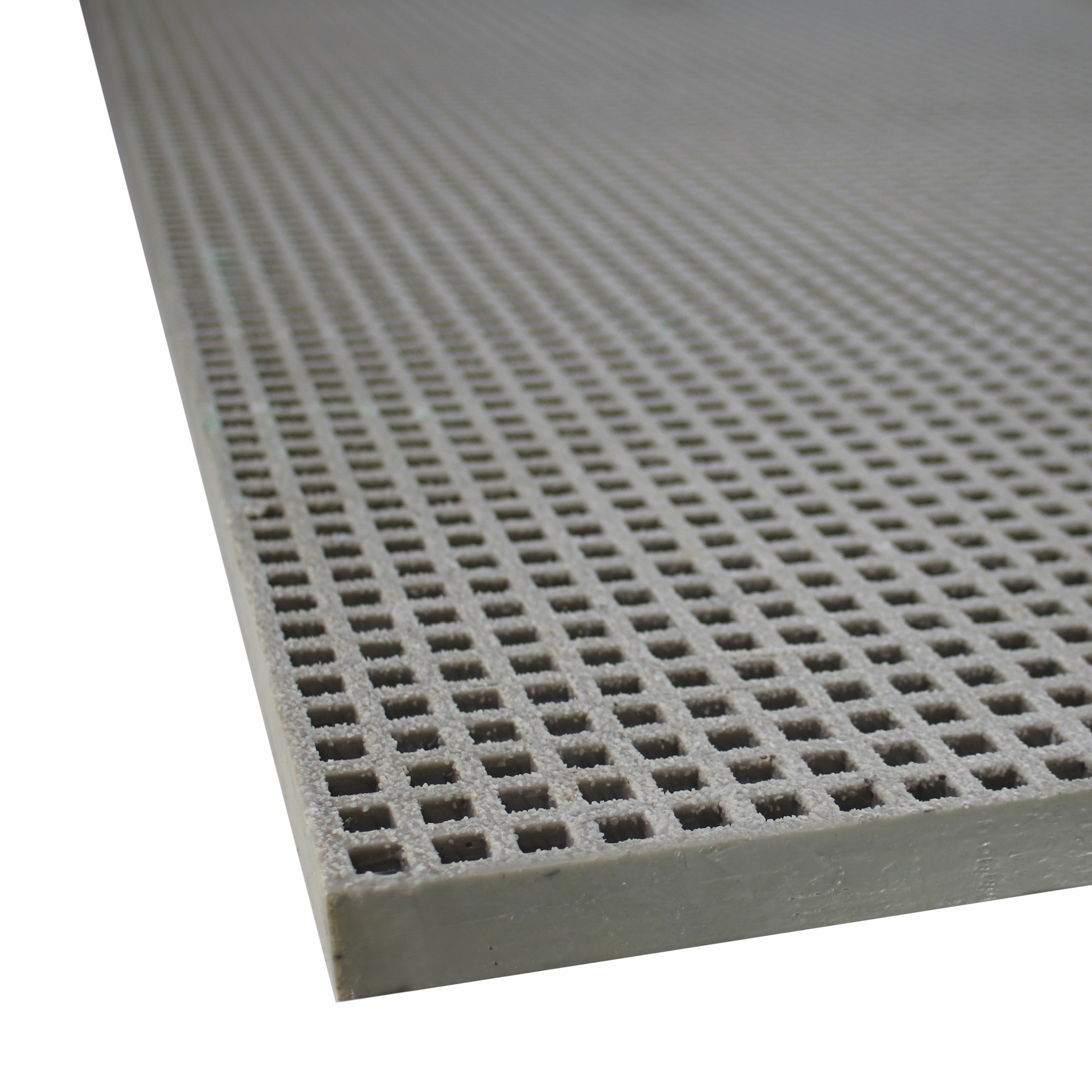
Public-facing access
Use mini mesh where standard mesh may feel too open for regular foot traffic, customer-facing routes or operational areas with varied footwear.
Dropped-object reduction
Smaller mesh openings can help reduce the risk of tools, fixings and small items passing through the floor into lower-level work areas.
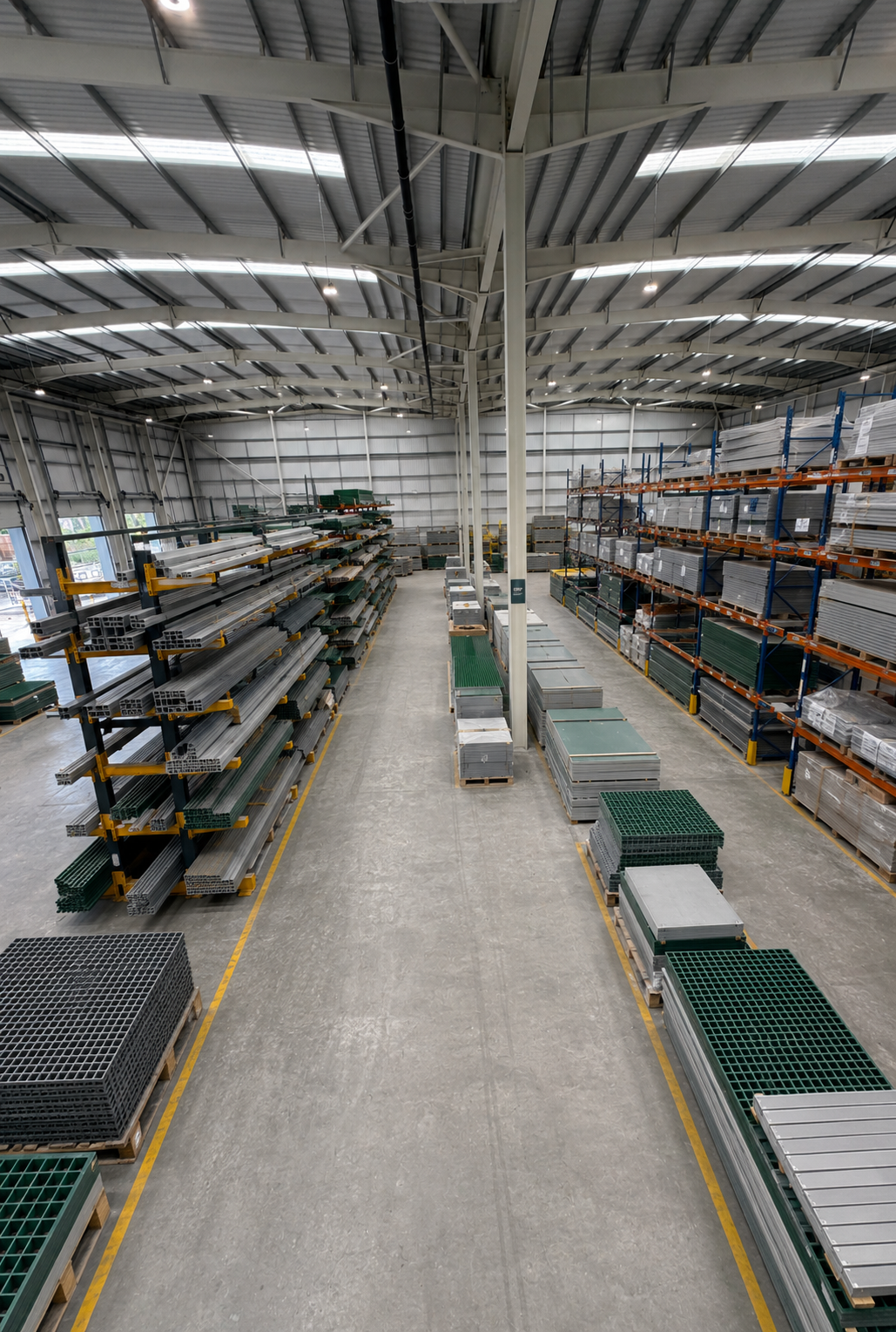
Stocked project supply
Order panels for site cutting, or ask GRP Express to prepare repeat sizes, awkward shapes and job-ready panel packs before delivery.
Specification checks
Opening requirement
Decide whether the reason for mini mesh is footwear confidence, wheels, dropped objects or public access. That choice affects mesh, thickness and fixing detail.
Load and span
Mini mesh still needs the same structural checks as standard grating: clear span, load category, panel orientation, support width and deflection expectations.
Cleaning and drainage
Mini mesh allows drainage but blocks more debris than standard mesh. For closed containment, compare solid top GRP grating instead.
Edges and openings
Plan trim, panel edges, hatches and cut-outs before ordering so site teams are not forced into awkward cutting around services.
Mini mesh compared
| Grating route | Why choose it | Limitations to check |
|---|---|---|
| Mini mesh | Smaller openings for pedestrian confidence, reduced dropped-object risk and access routes with mixed users. | May need more cleaning attention where heavy solids collect on the surface. |
| Standard mesh | Best all-rounder for drainage, airflow and general industrial access. | Larger openings may not suit all pedestrian or small-wheel conditions. |
| Solid top | Closed anti-slip surface for debris control and visual screening. | Heavier and needs separate drainage planning. |
Not sure whether mini mesh is necessary?
Send the location, user type, footwear/wheel concerns, span and environment. We can help decide whether mini mesh, standard mesh or solid top is the cleaner route.

Mini mesh FAQs
Is mini mesh the same as solid top?
No. Mini mesh still has openings for drainage and airflow. Solid top is a closed anti-slip surface bonded to a grating base.
Can mini mesh be used outside?
Yes, subject to load, fixing and environment checks. GRP is often used outside because it resists corrosion and does not need repainting like steel.
Can GRP Express cut mini mesh panels?
Yes. Share dimensions, drawings or a cut list and we can advise on panel yield, orientation, edge support and repeat preparation.
Technical grating checkpoint
Mini mesh: specify the clear opening and intended user
Reduced-aperture grating can improve underfoot comfort and reduce the passage of small items, but “mini mesh” is not a universal dimensional standard. Declare the actual clear opening and verify loading independently.
| Specification area | What to establish | Engineering boundary |
|---|---|---|
| Structural data | Exact mini-mesh depth, clear span, point/UDL and deflection. | Do not assume mini mesh matches standard-mesh performance at the same nominal depth. |
| Accessibility | Applicable building, station, client and inclusive-design requirements. | Smaller openings may help but do not alone establish wheelchair or public-access compliance. |
| Machinery platforms | BS EN ISO 14122-2 where the main function is permanent access to stationary machinery. | Confirm openings, falling-object risk and project risk assessment. |
| Cut planning | Perimeter support, bearing direction, joints and small remnants. | Reduced aperture does not remove the need for adequate bearing and panel restraint. |
Important: Avoid blanket terms such as “heel safe” or “finger safe” unless the stated clear opening is tied to the exact applicable requirement and use.
Primary references: relevant current parts of BS 4592; ISO 14122-2:2016 where machinery access is in scope; and project-specific load, fire, chemical and access requirements.
Mini-mesh design checkpoint
Smaller openings improve containment—but change the whole selection
Mini mesh can reduce dropped-object risk and improve confidence for some pedestrian uses, but the actual clear aperture, wheel geometry, drainage, cleaning, load data and edge details must still be checked. The product name alone does not prove an accessibility outcome.
Opening control
- State the maximum permitted clear opening.
- Check footwear, mobility aids, trolley wheels and dropped-object hazards separately.
- Coordinate gaps at walls, kerbs, penetrations and removable panels.
- Confirm that cuts do not create larger local openings.
Hydraulic and process effects
- Smaller openings can retain more dirt, ice or process solids.
- Verify drainage capacity for the expected water and debris load.
- Plan cleaning access and safe removal of contamination.
- Do not treat open area as a substitute for a drainage calculation.
Structural and installation checks
- Use mini-mesh-specific load data, not standard-mesh tables.
- Verify clear span, local point loads and support bearing.
- Support cut edges and narrow strips.
- Choose clips compatible with the actual mesh geometry.
Public-access claims need project evidence
Smaller mesh may be a better starting point for public routes or small wheels, but accessibility depends on the complete route: opening dimensions, gradients, level changes, surface, drainage, handrails and the users defined by the project.
Mini-mesh technical FAQs
Does mini mesh automatically meet accessibility requirements?
No. Confirm the actual aperture, route geometry, wheels or mobility aids, surface, drainage and the applicable project requirements.
Can I use a standard-mesh load table?
No. Use data for the exact mini-mesh product, depth, resin and support arrangement because its construction and stiffness may differ.
Why do cut edges need extra attention?
Cutting can interrupt load paths and create larger edge openings or narrow bars. The cut plan must preserve support, edge restraint and the required aperture control.
Does smaller mesh drain as freely as standard mesh?
Not necessarily. Smaller apertures and retained debris can reduce effective drainage, so water flow, contamination and maintenance must be assessed for the site.
Use mini mesh grating where smaller apertures and pedestrian access matter
Mini mesh GRP grating helps reduce opening size while keeping drainage, corrosion resistance and anti-slip surface benefits. It is often considered for public access, pedestrian routes, platforms and service areas.
Compare mesh options
Review standard mesh, mini mesh and solid top routes before choosing the panel format.
Compare GRP gratingCheck slip-risk areas
For worn or wet pedestrian surfaces, compare grating with anti-slip sheets, strips and covers.
View anti-slip productsAsk for cut support
Send dimensions, drawings or a cut list where panels need trimming, shaping or repeated sizes.
Project supportContinue the grating route
Compare grating types, check loading and move into cutting support.
Use these links to keep customers and crawlers moving through the complete GRP grating decision path.
Available to buy: Mini Mesh GRP Grating
Shop mini mesh grating for smaller apertures and pedestrian-focused access routes, with project cutting support available where needed.
-

Beige GRP Mini Mesh – 30mm – 3007 x 1007mm
£221.22 inc VAT£184.35 ex VAT Add to basket -
Beige GRP Mini Mesh – 38mm – 4047 x 1247mm
£437.88 inc VAT£364.90 ex VAT Add to basket -

Beige Mini Mesh GRP Grating
Price range: £141.74 through £368.27 inc VAT Price range: £118.12 through £306.89 ex VAT Select options This product has multiple variants. The options may be chosen on the product pageAvailable configurations 7 purchasable options
MM-14-30-10-BE-G
Beige Mini Mesh GRP Grating – 14mm, 3007 × 1007mm
- Grating Depth
- 14mm
- Panel Size
- 3007 × 1007mm
300.7 × 100.7 × 1.4 cm 30.28 kg£141.74 inc VAT£118.12 ex VAT Choose this option
MM-14-36-12-BE-G
Beige Mini Mesh GRP Grating – 14mm, 3647 × 1247mm
- Grating Depth
- 14mm
- Panel Size
- 3647 × 1247mm
364.7 × 124.7 × 1.4 cm 48 kg£222.73 inc VAT£185.61 ex VAT Choose this option
MM-22-30-10-BE-G
Beige Mini Mesh GRP Grating – 22mm, 3007 × 1007mm
- Grating Depth
- 22mm
- Panel Size
- 3007 × 1007mm
300.7 × 100.7 × 2.2 cm 48.45 kg£182.23 inc VAT£151.86 ex VAT Choose this option
MM-22-40-12-BE-G
Beige Mini Mesh GRP Grating – 22mm, 4047 × 1247mm
- Grating Depth
- 22mm
- Panel Size
- 4047 × 1247mm
404.7 × 124.7 × 2.2 cm 65 kg£270.83 inc VAT£225.69 ex VAT Choose this option
MM-22-40-15-BE-G
Beige Mini Mesh GRP Grating – 22mm, 4047 × 1527mm
- Grating Depth
- 22mm
- Panel Size
- 4047 × 1527mm
404.7 × 152.7 × 2.2 cm 98.88 kg£343.72 inc VAT£286.43 ex VAT Choose this option
MM-30-40-12-BE-G
Beige Mini Mesh GRP Grating – 30mm, 4047 × 1247mm
- Grating Depth
- 30mm
- Panel Size
- 4047 × 1247mm
404.7 × 124.7 × 3 cm 94.88 kg£367.01 inc VAT£305.84 ex VAT Choose this option
MM-38-30-12-BE-G
Beige Mini Mesh GRP Grating – 38mm, 3007 × 1247mm
- Grating Depth
- 38mm
- Panel Size
- 3007 × 1247mm
300.7 × 124.7 × 3.8 cm 88.2 kg£368.27 inc VAT£306.89 ex VAT Choose this option -

Black Mini Mesh GRP Grating
Price range: £141.74 through £298.67 inc VAT Price range: £118.12 through £248.89 ex VAT Select options This product has multiple variants. The options may be chosen on the product pageAvailable configurations 4 purchasable options
MM-14-30-10-BK-G
Black Mini Mesh GRP Grating – 14mm, 3007 × 1007mm
- Grating Depth
- 14mm
- Panel Size
- 3007 × 1007mm
300.7 × 100.7 × 1.4 cm 30.28 kg£141.74 inc VAT£118.12 ex VAT Choose this option
MM-14-36-12-BK-G
Black Mini Mesh GRP Grating – 14mm, 3647 × 1247mm
- Grating Depth
- 14mm
- Panel Size
- 3647 × 1247mm
364.7 × 124.7 × 1.4 cm 45.48 kg£222.73 inc VAT£185.61 ex VAT Choose this option
MM-22-30-10-BK-G
Black Mini Mesh GRP Grating – 22mm, 3007 × 1007mm
- Grating Depth
- 22mm
- Panel Size
- 3007 × 1007mm
300.7 × 100.7 × 2.2 cm 48.45 kg£182.23 inc VAT£151.86 ex VAT Choose this option
MM-38-30-10-BK-G
Black Mini Mesh GRP Grating – 38mm, 3007 × 1007mm
- Grating Depth
- 38mm
- Panel Size
- 3007 × 1007mm
300.7 × 100.7 × 3.8 cm 69.95 kg£298.67 inc VAT£248.89 ex VAT Choose this option